
EDP vs EDT vs Extrait: Perfume Concentrations Explained
Compare EDT, EDP and extrait de parfum, understand concentration and wear time, and discover how perfume oils differ before choosing a fragrance.
The main difference between eau de toilette (EDT), eau de parfum (EDP) and extrait de parfum is usually fragrance concentration. But the label alone cannot tell you exactly how a perfume smells, how far it projects or how long it lasts. Different versions of the same fragrance can also use different compositions, so it is worth sampling the version you intend to buy.
This guide explains the concentration ranges, the difference between perfume oil and extrait, and how to choose a fragrance by the way it wears.
EDT vs EDP vs extrait: a quick comparison
| Label | Full name | Typical concentration | What to know |
|---|---|---|---|
| EDC | Eau de Cologne | 3–8% | Often associated with fresh styles; the name alone does not specify wear time. |
| EDT | Eau de Toilette | 5–15% | Usually less concentrated than an EDP within the same range; compare the actual scent. |
| EDP | Eau de Parfum | 10–20% | Often more concentrated than an EDT, but can have a different balance of notes. |
| Extrait / Parfum | Perfume extract | 15–40% | Often a concentrated interpretation; greater projection is not guaranteed. |
These are common usage ranges, not universal rules. They overlap, and individual houses may use different concentrations. The International Fragrance Association (IFRA) explains that these terms are not strictly defined by international standards. The percentages describe fragrance concentrate in the finished product; they do not mean that the product contains that percentage of natural essential oils.
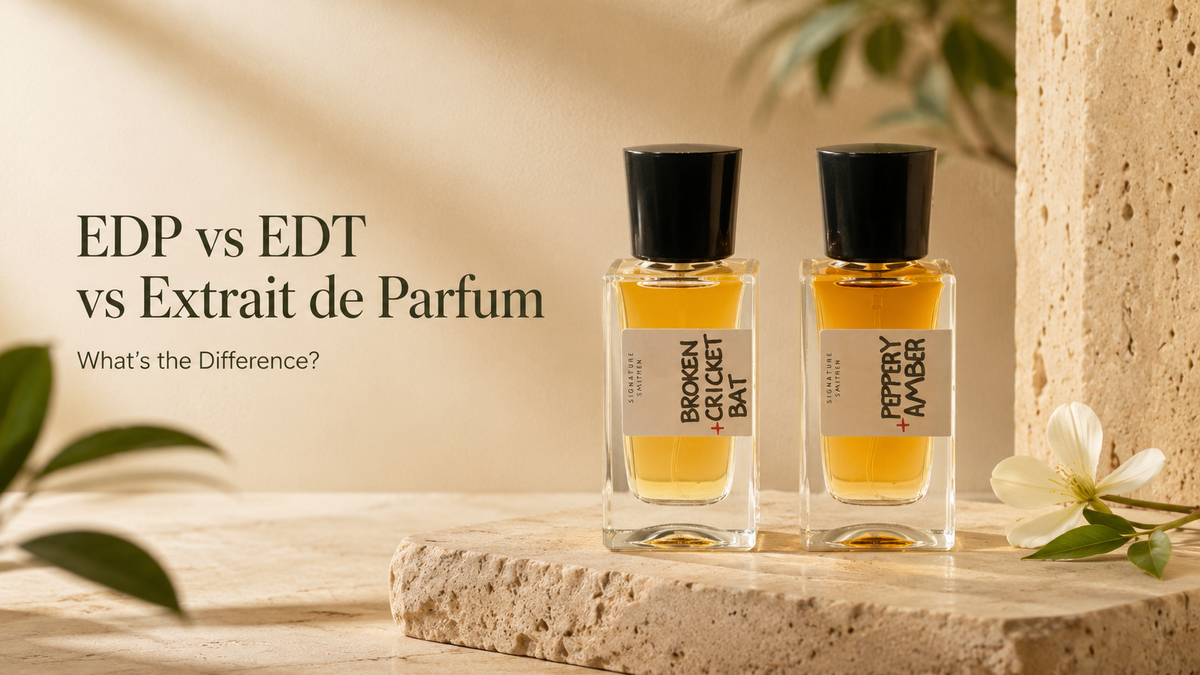
What is the difference between eau de toilette and eau de parfum?
An EDT is usually less concentrated than an EDP in the same fragrance range. However, buying the EDP does not necessarily mean getting an identical scent at a higher strength.
A house may adjust the materials or the balance of notes for each version. One may emphasise a bright opening, while another gives more space to woods, flowers or amber. Those differences depend on the particular perfume, rather than on a rule that applies to every EDT or EDP.
If you enjoy an EDT, try its EDP separately before buying. Compare the opening, the scent after it has settled and the way it feels later in the day.
Extrait de parfum vs eau de parfum
Extrait de parfum usually describes a more concentrated format than eau de parfum within a house's range. It may also be a distinct interpretation of the fragrance, with changes to the composition.
Do not assume an extrait will smell louder, fresher or better than its EDP counterpart. A concentrated fragrance can feel close to the skin, while another formula creates a more noticeable trail. Amouage's explanation of concentration also notes that its effect on performance varies with the formula.
Is parfum the same as extrait de parfum?
Parfum and extrait de parfum are often used for concentrated fragrance formats. Check how the individual brand describes its product rather than treating the names as a precise, universal percentage. “Perfume” is also used in everyday English for fragrance generally, so context matters when comparing perfume with EDT or EDP.
Perfume oil vs extrait de parfum: what is the difference?
Perfume oil describes a format; extrait de parfum describes a concentration category. A perfume oil is commonly a fragrance blend in an oil carrier, often applied with a rollerball or dabber. An extrait may be an alcohol-based spray. Neither name alone tells you the exact concentration or ingredients.
An oil-based perfume is not automatically pure fragrance concentrate, and an extrait is not automatically alcohol-free. Check the product description and ingredient information for the specific bottle.
When comparing them, consider the application method as well as the scent. A dabbed oil and a spray can distribute fragrance differently. Try both on separate occasions and compare the scent close to your skin, its presence around you and how it changes over time.
Which lasts longer: EDT, EDP or extrait?
A higher concentration can contribute to longer wear, but there is no reliable number of hours that applies to every EDT, EDP or extrait. The materials, composition, amount applied, skin and environment all affect the result.
It helps to separate three ideas:
- Longevity: how long you can detect the fragrance.
- Projection: how far the scent is noticeable around you.
- Sillage: the scent trail left as you move.
A perfume can remain detectable close to your skin after its projection has softened. That is why “long-lasting” and “strong” are not interchangeable descriptions.
Is EDP better than EDT?
The better choice is the version you enjoy wearing. Concentration is useful information, but it is not a quality score.
For work or shared spaces, assess the actual fragrance and how much you apply rather than choosing by concentration alone. For an evening or a long day, test whether you still enjoy the scent later in the wear. A more expensive format only offers value if its scent and performance suit you.
How to compare fragrance samples
- Sample the exact version. Check whether the sample is EDT, EDP or extrait.
- Wear each on a separate day. Use a comparable amount and note your application.
- Check it at different stages. Record the opening, the settled scent and your impression later in the day.
- Repeat before deciding. Choose the version you want to wear again, rather than relying on the first spray.
Explore Signature Smithen Eau de Parfum
Both Signature Smithen fragrances are Eau de Parfum. They offer different scent profiles to explore:
- Broken Cricket Bat 50ml Eau de Parfum: a woody aromatic composition with pink pepper and cardamom, a cedarwood heart, and sandalwood and oud in the base.
- Peppery Amber 50ml Eau de Parfum: pink pepper and clove, leather and cedarwood, then amber and vanilla.
Start with a Broken Cricket Bat 1.5ml sample or a Peppery Amber 1.5ml sample to judge the fragrance on your own skin. You can also explore both in the Discovery Duo perfume sample set.
Frequently asked questions
What do EDT and EDP stand for?
EDT stands for eau de toilette; EDP stands for eau de parfum. They are commonly used concentration labels, with ranges that can vary between fragrance houses.
Is extrait always stronger than EDP?
It is often more concentrated within a brand's range, but concentration does not guarantee greater projection or a particular wear time. Compare the individual formulas.
Can EDT and EDP smell different?
Yes. Versions with the same fragrance name may use different compositions or balances of notes, so sample the exact version you plan to buy.
Does a 50ml bottle have a different concentration from a sample?
Bottle size and concentration are separate measurements. Signature Smithen's 1.5ml samples contain the same Eau de Parfum as the corresponding 50ml bottles.
Continue Reading


